OUR 10 ANTI-POVERTY AREAS
Why Help Our Aid Recipients Break the Poverty Cycle?
Our purpose is to bring urgent relief to vulnerable families affected by poverty. Food For The Poor upholds the universal value of preserving human dignity while compassionately caring for those in need. The poverty cycle, also called the "poverty trap," is a self-reinforcing system where poverty persists because multidimensional factors create barriers to escaping it. The cycle often traps individuals, families, and communities across generations unless significant interventions are made.
The Main Poverty Causes or Poverty Traps
Lack of Resources
Insufficient income, assets, or access to basic needs such as food, clean water, and shelter. This leads to poor living conditions and deteriorating health.
Poor Health and Malnutrition
Lack of health care and poor nutrition lead to illnesses, reduced ability to work, and higher health care costs. These issues perpetuate low productivity and increased financial strain.
Low Productivity and Employment
Limited education and resources result in low-paying, unstable jobs or unemployment. Productivity stagnates, and individuals cannot earn enough to break out of poverty.
Limited Access to Education and Skills
Inability to afford quality education or vocational training. This results in low literacy levels and limited skill development, reducing employment opportunities.
Social and Economic Exclusion
Limited access to social services, financial systems, and economic opportunities. Marginalized individuals face systemic barriers that reinforce the cycle.
Intergenerational Poverty
The effects of poverty are passed down to the next generation through poor health, education, and financial instability. Without intervention, the cycle continues.
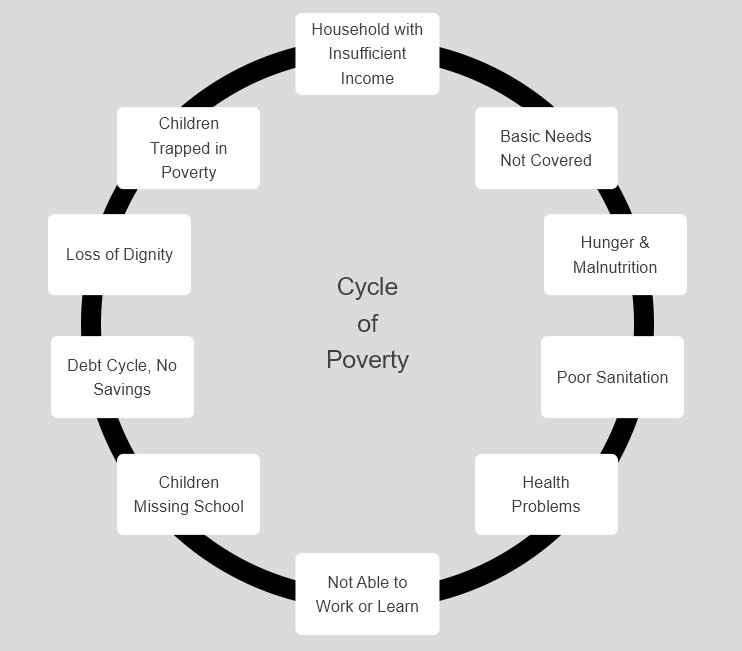
The Cycle of Poverty
Poverty traps are not isolated factors, they accumulate on top of one another, creating a complex layered system that is difficult to escape. Treating only one poverty cause at a time only results in a short-lived impact.
Limited access to education leads to low-paying jobs, which prevent families from affording health care, nutritious food, and proper housing, further weakening their ability to work and earn a stable income. Poor health and sanitation increase medical costs and reduce productivity, while financial exclusion prevents individuals from saving or investing in opportunities for economic growth. Additionally, economic instability and social exclusion leave marginalized groups without access to health care, education, and jobs. Each of these barriers amplifies the others, making it nearly impossible for individuals to break free from poverty without comprehensive support. Addressing multiple aspects — such as education, health care, financial inclusion, and infrastructure — is essential to breaking the cycle and creating sustainable pathways out of poverty.
10 ANTI-POVERTY FOCUS AREAS
We designed our assistance programs to empower our beneficiaries to become self-sufficient and ultimately inspire them to build strong communities so their members can help each other. We constantly seek simple, efficient strategies to fight hunger and poverty without adversely impacting our aid recipients or their country.
To have a lasting impact, Food For The Poor has implemented a wholistic approach relying on in country partners who help implement solutions in their field of expertise. It centers around our 10 Anti-Poverty Focus Areas: